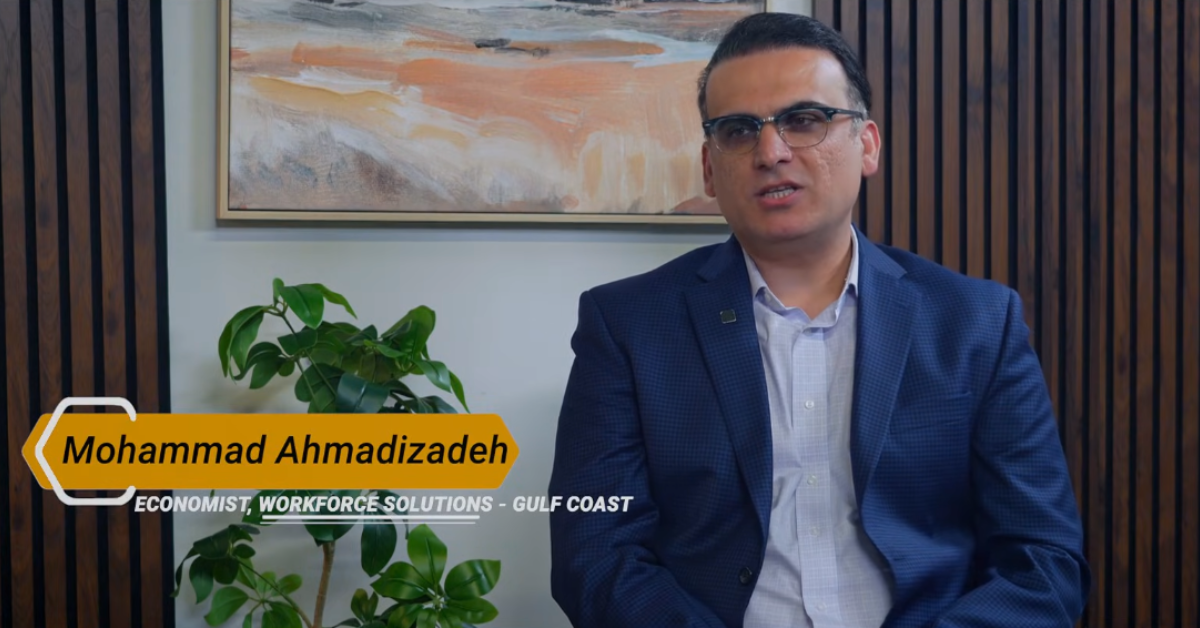
Houston employers are expected to add approximately 30,000 jobs by the end of 2026, according to Workforce Solutions Gulf Coast’s updated employment forecast. In a recent discussion, Workforce Solutions Gulf Coast Executive Director Juliet Stipeche and Economist Mohammad Ahmadizadeh explained why the forecast changed, which industries are expected to continue hiring, and how artificial intelligence is influencing today’s labor market.
Why the Forecast Changed
Ahmadizadeh explained that Workforce Solutions updates its employment forecast as new economic information becomes available. Since the original projection was released earlier this year, economists have incorporated additional employment data, revised benchmarks, changes in oil prices, and broader economic conditions into the forecast.
The updated outlook projects Houston will add about 30,000 jobs by the end of the year, reflecting continued, though more moderate, employment growth across the region.
Construction and Healthcare Continue to Drive Hiring
“Construction has been the main industry adding jobs over the last two years, and we expect it to remain one of the strongest sectors,” Ahmadizadeh said.
Construction is expected to remain one of Houston’s strongest sources of job growth, continuing a trend that has fueled the regional economy over the past two years. Ahmadizadeh also pointed to healthcare and social assistance as another leading sector, with approximately 5,000 new jobs projected by year-end.
Professional and business services, which experienced slower growth earlier this year, are also expected to improve as activity in the energy sector strengthens.
Ahmadizadeh noted that Houston’s economy has become more diversified over time. While oil and gas remains an important part of the regional economy, industries such as construction, healthcare, and port-related activity now account for a larger share of employment growth than they did a decade ago.
AI Is Reshaping Entry-Level Hiring
The conversation also examined how artificial intelligence is changing hiring, particularly for students and individuals entering the workforce.
Ahmadizadeh referenced recent research suggesting employers may hire fewer entry-level workers as AI takes over some routine tasks. At the same time, he emphasized that businesses still need to develop future talent and encourage job seekers to learn how AI can complement their work rather than view it solely as a threat.
“Learn more about AI and see how it can change your career,” Ahmadizadeh said. “It will create new opportunities, and people who understand how to use those tools will be more competitive.”
He advised students and early-career professionals to become familiar with AI tools, noting that individuals who know how to use the technology effectively will be better positioned as employers continue adopting AI across industries.
Skilled Trades Continue to Offer Strong Career Opportunities
While AI is expected to change many office-based occupations, Ahmadizadeh explained that careers requiring technical and hands-on skills remain in strong demand. Construction, manufacturing, healthcare, and many skilled trades continue to rely on workers whose responsibilities cannot easily be automated.
These industries continue to offer stable career opportunities while Houston’s economy grows and major infrastructure and development projects move forward.
You can watch the full discussion here:
Explore in-demand careers and connect with top employers at upcoming Workforce Solutions hiring events. Register today to secure your spot and access career-building resources.