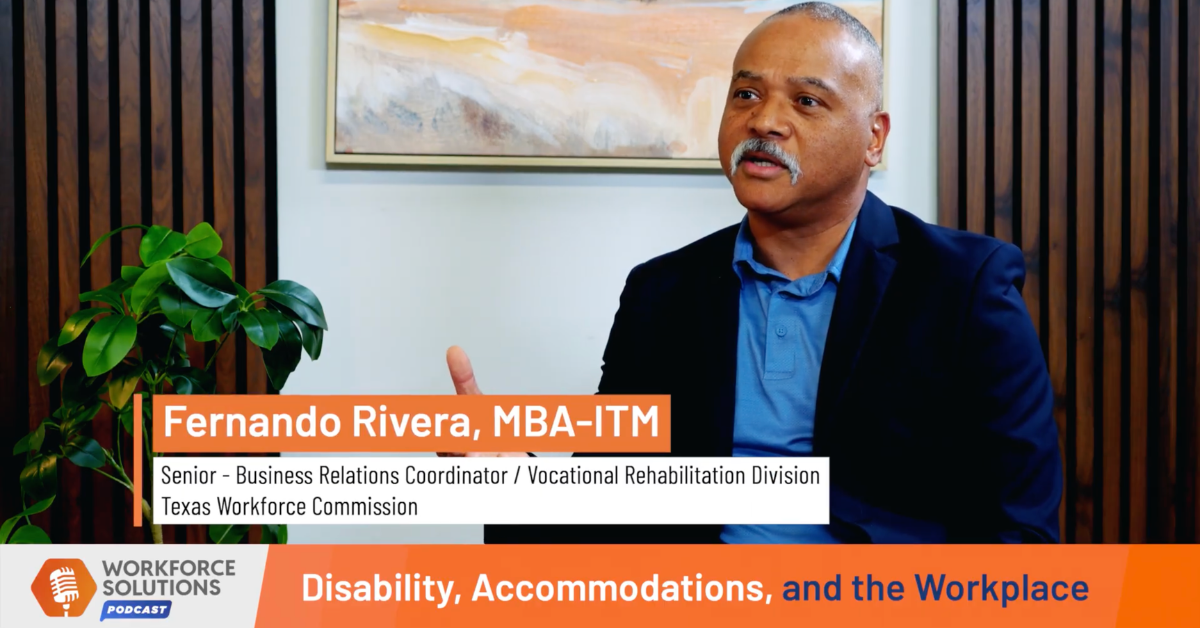
In a recent episode of the Workforce Solutions podcast, Juliet Stipes, executive director of the Gulf Coast Workforce Board, spoke with Fernando Rivera Jr. of the Texas Workforce Commission Vocational Rehabilitation Program about workplace accommodations and common employer concerns.
Rivera shared practical examples of how small adjustments can help employees with disabilities perform their jobs without changing the expectations of the position. He also discussed why employers may be overlooking qualified candidates when they are unfamiliar with the accommodations available.
Simple Adjustments Can Help Employees Succeed
During the conversation, Rivera explained that the word “accommodations” can make employers think a change will be complicated or expensive. But some solutions are as straightforward as providing a headset to an employee who is distracted by noise in a call center.
As Rivera explained:
“In fact, an accommodation can be something very simple. Let’s say we work in a call center and it’s a little too loud. Giving one of your employees a headset is an accommodation. That’s simple.”
He also described examples involving lighting and work schedules. An employee who has difficulty working under bright lights might benefit from a lamp or adjusted lighting. In another situation, an employer could shift an employee’s schedule from 8 a.m. to 7:30 a.m.–4:30 p.m.
These adjustments do not necessarily change what the employee is expected to accomplish. They can address a specific barrier so the employee can perform the job.
Changing Employer Perceptions
Rivera said employers sometimes assume accommodations will be difficult to implement. In his work, he helps them recognize that practical solutions may already be available.
“What we try to do is bring it to the forefront of their mind. Most employers already know these things. They say, ‘I know that. Why are you here again, Fernando?’ And I say, ‘To remind you that it’s there,’” said Rivera.
He also identified a misconception he hopes to change: the belief that a person with a disability will be a liability to a business. Rivera indicated that Texas Workforce Commission Vocational Rehabilitation Services addresses that concern with statistics, facts, numbers and testimony.
An Overlooked Talent Pool
The conversation also turned to employers who say they are struggling to find workers. Rivera said some may be missing qualified candidates with disabilities because they are not familiar with this talent pool.
“They’re missing the talent pool. When I meet with employers, one of the main complaints I hear right now is, ‘I can’t find anyone to do this job.’ And in the back of my mind I’m thinking, I know why. There’s a talent pool they aren’t tapping into and probably aren’t even aware of.”
Through his work with employers, Rivera helps introduce them to this talent pool and address concerns about accommodations.
Listen to the Workforce Solutions Podcast
Hear Juliet Stipes and Fernando Rivera Jr. discuss workplace accommodations, employer misconceptions, and the talent pool of people with disabilities in the Workforce Solutions podcast.
Explore in-demand careers and connect with top employers at upcoming Workforce Solutions hiring events. Register today to secure your spot and access career-building resources.