
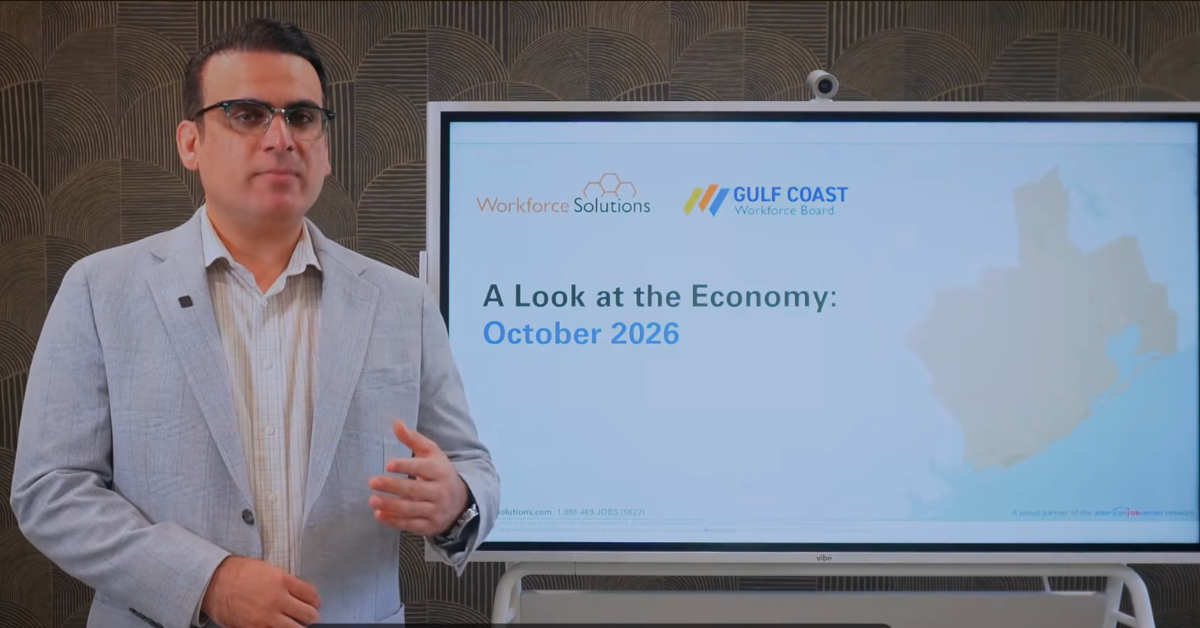
If you’re looking for work in the Houston area, there’s good news in the latest numbers. In August, the region had 44,700 more jobs than it did a year earlier. That’s the strongest year-over-year gain in more than a year, and well above the 17,000 annual gain at the start of 2026.
In the latest episode of A Look at the Economy, Gulf Coast Workforce Board economist Mohammad Ahmadizadeh walks through those numbers. He also covers what the Federal Reserve’s recent rate increase could mean and why advanced manufacturing is a sector to watch.
Hiring was strong in late spring
Ahmadizadeh said part of the year-over-year gain reflects real hiring, especially in May and June. Part of it comes from comparing against a weak 2025, when job growth slowed sharply in the second half of the year. He expects that comparison to keep annual numbers elevated through the fall. The board forecasts that Houston will add about 30,000 jobs in 2026, measured December to December.
The summer was quieter. Houston lost 28,300 jobs in July, which is common when the school year ends and some education workers temporarily come off the payroll. August usually brings many of those jobs back. This year the region added only 900, compared with a typical August gain of 7,700.
“Two months do not make a trend,” Ahmadizadeh said, “but they tell us that the hiring momentum we saw from April through June has cooled.”
For job seekers, the takeaway is that employers are still hiring, but hiring is moving more slowly than it did in late spring.
Houston’s inflation is lower than the nation’s
Houston’s inflation was 1.3% in August, compared with 3.4% nationally. Ahmadizadeh said the main difference is housing costs. Local energy prices still rose about 17% and gasoline about 13%. Houston’s inflation has stayed below the national rate since early 2024. He noted that lower inflation is usually good news for household budgets, though it isn’t the same thing as affordability.
What the Fed’s rate increase could mean
On September 16, the Federal Reserve raised interest rates by a quarter point, its first increase since July 2023. Another increase is possible before the end of the year.
Ahmadizadeh said rate changes take a while to reach the job market. The last time the Fed raised rates sharply, Houston kept adding more than 160,000 jobs over the year well into the hiking cycle. Growth slowed later.
“Monetary policy usually works with a lag,” he said.
He expects higher borrowing costs to weigh most on construction, real estate and businesses that depend on consumer spending, with the main effects arriving late this year and into 2027. Higher oil prices give Houston some support that most other regions don’t have. For people job hunting now, those industry differences are worth knowing.
Advanced manufacturing
The second half of the episode focuses on advanced manufacturing. The Houston region has attracted major new investments in pharmaceuticals, AI hardware, batteries and space. Apple and Foxconn are producing AI servers in northwest Houston, and the region has several solar manufacturers.
These plants are highly automated, so they need fewer workers for every dollar invested than traditional factories. The jobs they do create are different.
“The jobs that they create are more technical and for sure going to pay well,” Ahmadizadeh said.
Ahmadizadeh describes advanced manufacturing as having a large share of STEM and technician jobs. In Houston, advanced manufacturing jobs are about 56% above their 1990 level, compared with 24% for the rest of local manufacturing. Nationally, manufacturing jobs are still about 29% below 1990. Houston already has a presence in several advanced manufacturing segments, including AI hardware, pharmaceuticals, batteries and energy storage, and aerospace. For job seekers with technical skills, or anyone thinking about technician training, this is a part of the regional economy where well-paying work is expected to grow.
You can watch the full episode with charts here:
Explore in-demand careers and connect with top employers at upcoming Workforce Solutions hiring events. Register today to secure your spot and access career-building resources.